Emergency RV AC Repair in Grandview, TX: What to Expect When You Call We Get Around
When your RV air conditioner quits in Grandview, TX during a 100°F July afternoon, it stops being a comfort issue and becomes a health risk fast. Grandview sits in Johnson County on the US-77/67 corridor — there is no RV dealership or same-day service shop in town, which means a mobile tech who drives to you is often the only fast option available.
This post walks you through exactly what happens from the moment you call through on-site diagnosis to resolution — so you know what to expect before you pick up the phone.
How Fast Can a Mobile Tech Reach You in Grandview?
Response time depends on the current call queue, but mobile RV AC service is available 24/7, including weekends and holidays, and Grandview is a reachable dispatch zone from the greater Johnson County area.
Grandview is roughly 30 miles south of Fort Worth and close to Burleson and Cleburne. That puts it within a practical service radius for a mobile tech who is already working calls in the surrounding area. When you call, you will get an honest estimated arrival window — not a vague 'we will be there soon.'
Because there is no local shop to drop your rig at, the mobile model is not a convenience here — it is the realistic path to a same-day fix.
What Happens When You Call?
The intake call is a quick triage, not a long form — the goal is to get a tech moving toward you while gathering the details needed to arrive with the right tools and parts.
You will be asked: what symptoms you are seeing (no power, blowing warm, not turning on), your RV make and model, the AC unit brand (Dometic, Coleman-Mach, Carrier, Advent are all common), your exact location in or around Grandview, and your current power source — shore power, generator, or battery. That last detail matters because a power issue can look exactly like a mechanical AC failure, and the tech needs to know what they are walking into.
After intake, a tech is dispatched and you get an ETA. You do not have to repeat your symptoms to a second person or wait on hold for a callback.
What Does the On-Site Diagnostic Process Actually Look Like?
A structured four-step check lets the tech rule out the most common causes quickly before opening anything up.
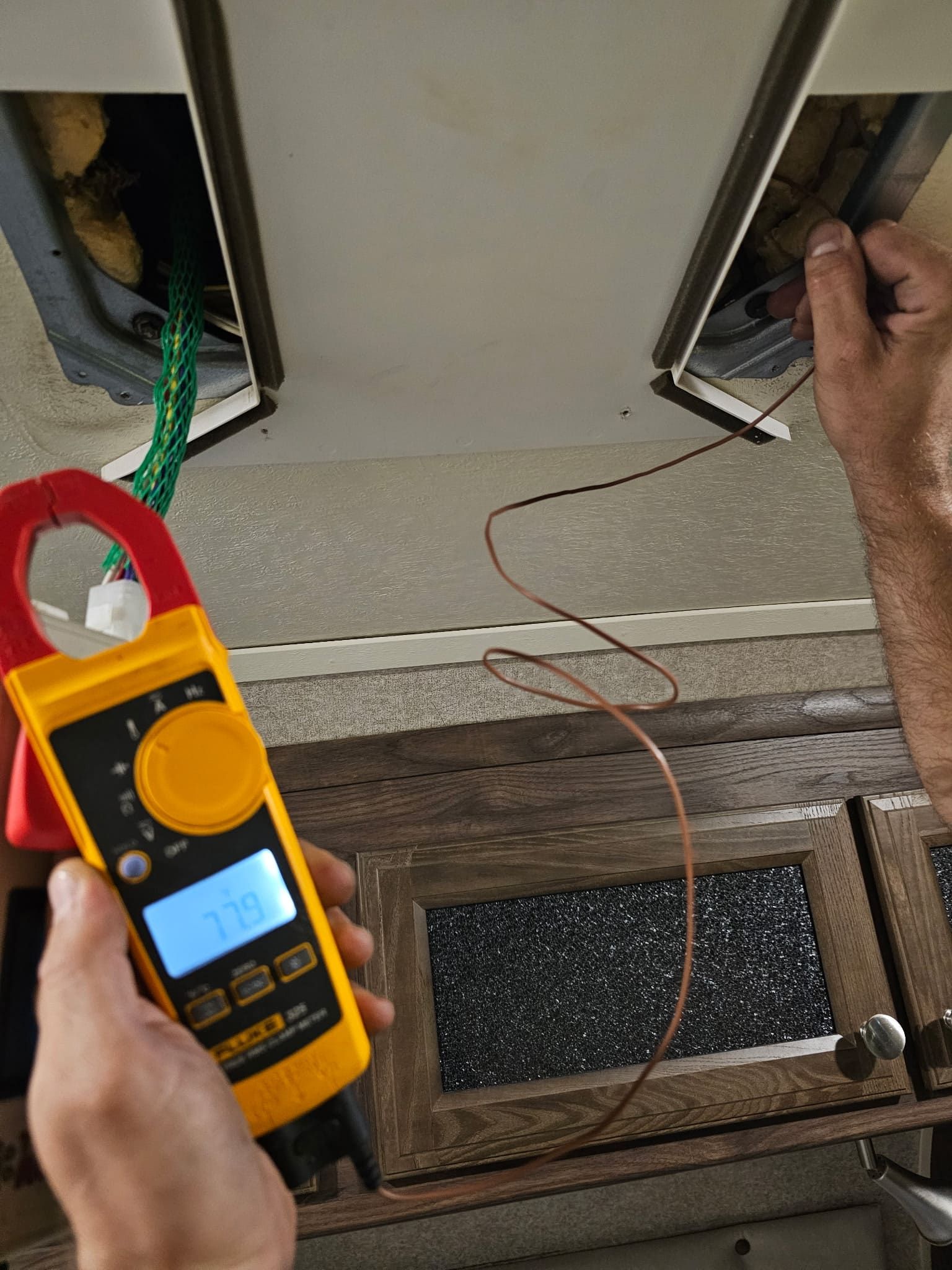
Step 1 — Electrical system first. Before touching the AC unit itself, the tech checks breakers, fuses, capacitors, and incoming voltage. A surprising number of 'AC failures' are actually electrical — a tripped breaker, a failed run capacitor, or a voltage drop from a weak shore power connection. This is also where RV electrical diagnostics becomes part of the emergency call. If your battery bank is underperforming or a solar charge issue is starving the system, that gets caught here too.
Step 2 — Thermostat and control board. A thermostat that reads correctly on the display but does not send the right signal to the compressor is one of the most common misdiagnoses in the field. The tech checks thermostat calibration, wiring continuity, and control board response. If this is the issue, it is usually one of the faster fixes on the list.
Step 3 — Refrigerant level and leak inspection. The tech runs a pressure test and visually inspects the evaporator and condenser coils for signs of a refrigerant leak. If the system is simply low on refrigerant with no active leak, an on-site recharge is often possible the same day. A major leak at the coil is a different conversation — that typically moves into parts-pending territory. Full details on what that repair involves are covered on the RV air conditioning repair and replacement service page.
Step 4 — Compressor and mechanical components. The tech checks compressor amp draw, fan motor operation, and the capacitor. If the compressor has seized or overheated and tripped its thermal overload, the overload reset is checked first — sometimes that is all it takes after sustained use in 100°F+ heat. A roof-mounted unit with a cracked housing or failed seal can also cause airflow problems that mimic a refrigerant issue.
Same-Day Fix or Parts Pending — What Honest Looks Like
Most emergency calls resolve the same day. The scenarios with the highest same-day fix rate include capacitor replacement, electrical faults, thermostat replacement or recalibration, refrigerant recharge with no major leak, and thermal overload resets.
Parts-pending situations are less common but they do happen. Compressor replacement, control board replacement, fan motor swaps, and major refrigerant coil repairs usually require a part that is not stocked on the truck. In those cases, the tech will give you a clear explanation of what failed, what the repair requires, and a realistic timeline — not a vague estimate designed to keep you waiting.
Knowing this distinction upfront means you will not be caught off guard either way.
Does 'No Fix, No Pay' Apply to Emergency Calls in Grandview?
Yes — the no-fix, no-pay policy applies to emergency calls. You are not charged for a repair that does not get completed, and the diagnostic process is transparent before any repair authorization is given.
If your RV is covered under a warranty or you have an insurance policy that covers mechanical failures, that coverage may apply to this visit. The warranty and insurance claim process can be handled as part of the service call — see the warranty and insurance repairs page for how that works in practice. Having your policy details on hand when you call can speed that up.
Johnson County Heat Makes Timing Critical
Grandview summers are not just hot — they are sustained-heat events where daytime temps stay above 95–100°F for weeks at a time. An RV AC unit running continuously under those conditions is under far more stress than the same unit used in a milder climate.
Compressor overheats, capacitor failures, and refrigerant pressure issues all increase in frequency during extended heat waves. If your AC worked fine in May and suddenly fails in August, the sustained load is likely a contributing factor — not just bad luck. The earlier in the day you catch a failing system and call, the more scheduling flexibility there is before temperatures peak in the afternoon.
Getting the system diagnosed quickly also protects other components — a compressor that keeps cycling on and off while struggling can damage the capacitor and control board if left running.
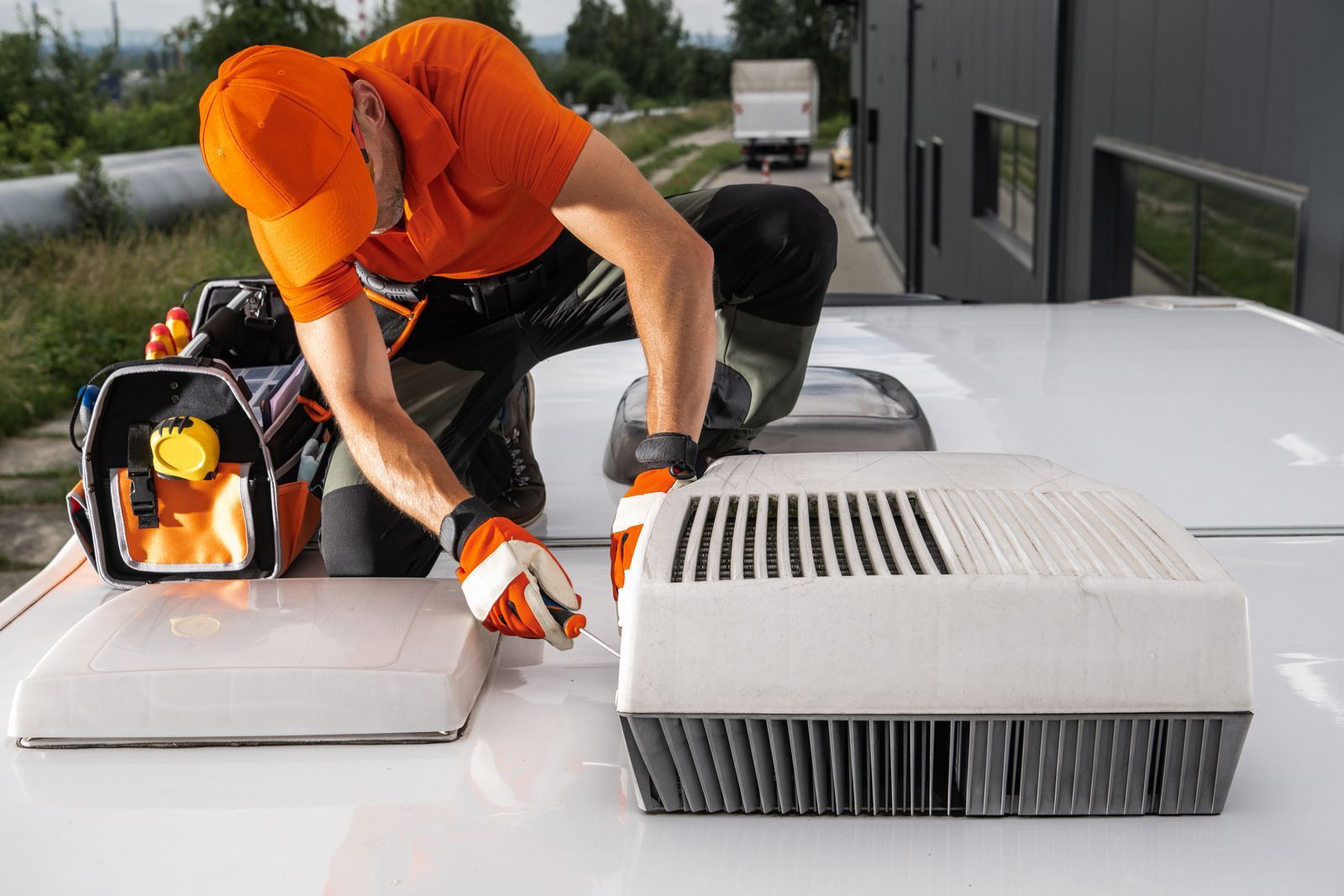
Same-day mobile RV AC service means you stay in your rig, at your site or driveway, without towing to a shop that may not have a same-day opening anyway.
Schedule your repair with We Get Around RV Repair — explore the full RV AC repair and replacement service to see what the visit covers before you call.