Comparing RV AC Electrical Diagnostics Methods in Grandview, TX
RV air conditioning electrical diagnostics involve systematically testing circuit breakers, wiring connections, compressor motor windings, capacitors, and control boards to isolate the specific electrical fault preventing the system from cooling properly or operating at all.
Grandview RV owners experiencing AC problems often face electrical issues rather than mechanical failures, making accurate diagnostics essential to avoid replacing parts unnecessarily. Professional electrical testing identifies the root cause quickly, saving time and money compared to trial-and-error repairs.
How Do Technicians Test Circuit Breakers and Power Supply
Electrical diagnostics begin by verifying that the air conditioner receives proper voltage at the rooftop unit, starting with the circuit breaker panel inside the RV.
Technicians use a multimeter to measure voltage at the breaker terminals, confirming that 120 volts AC reaches the breaker when shore power or a generator is connected. A reading significantly below 120 volts indicates a problem with the power source or the RV's main electrical panel, not the air conditioner itself.
The breaker is tested under load by turning on the air conditioner and measuring voltage drop as the compressor starts. Excessive voltage drop suggests a weak breaker, corroded connections, or undersized wiring that cannot handle the inrush current when the compressor motor engages.
If the breaker trips repeatedly, technicians measure the air conditioner's actual current draw and compare it to the breaker's rating. A compressor drawing more current than its nameplate specification indicates internal motor problems, while current draw within normal limits points to a breaker that has weakened over time and needs replacement. Owners interested in exploring electrical system help in Fort Worth can have the entire RV electrical system inspected to identify issues affecting multiple appliances and systems.
Which Tests Identify Compressor Motor and Capacitor Problems
Compressor motor testing involves measuring the resistance of the motor windings and checking for continuity between the windings and the compressor housing to detect shorts or open circuits.
A healthy compressor motor shows specific resistance values between its common, start, and run terminals, typically ranging from 2 to 20 ohms depending on the motor size. Infinite resistance indicates an open winding that prevents the motor from running, while zero resistance suggests a short that will trip the breaker immediately.
Technicians also check for continuity between each motor terminal and the compressor housing. Any continuity reading indicates a ground fault where the motor windings have shorted to the metal case, a condition that requires compressor replacement because the fault cannot be repaired.
Capacitor testing measures the capacitance value in microfarads and compares it to the rating printed on the capacitor body. A capacitor that tests more than 10 percent below its rated value is considered weak and should be replaced, even if it has not failed completely. Weak capacitors cause hard starting, increased current draw, and premature compressor failure.
Do Control Board Failures Require Complete Unit Replacement
Control board failures in RV air conditioners can often be repaired by replacing the board itself, a repair that costs significantly less than replacing the entire rooftop unit.
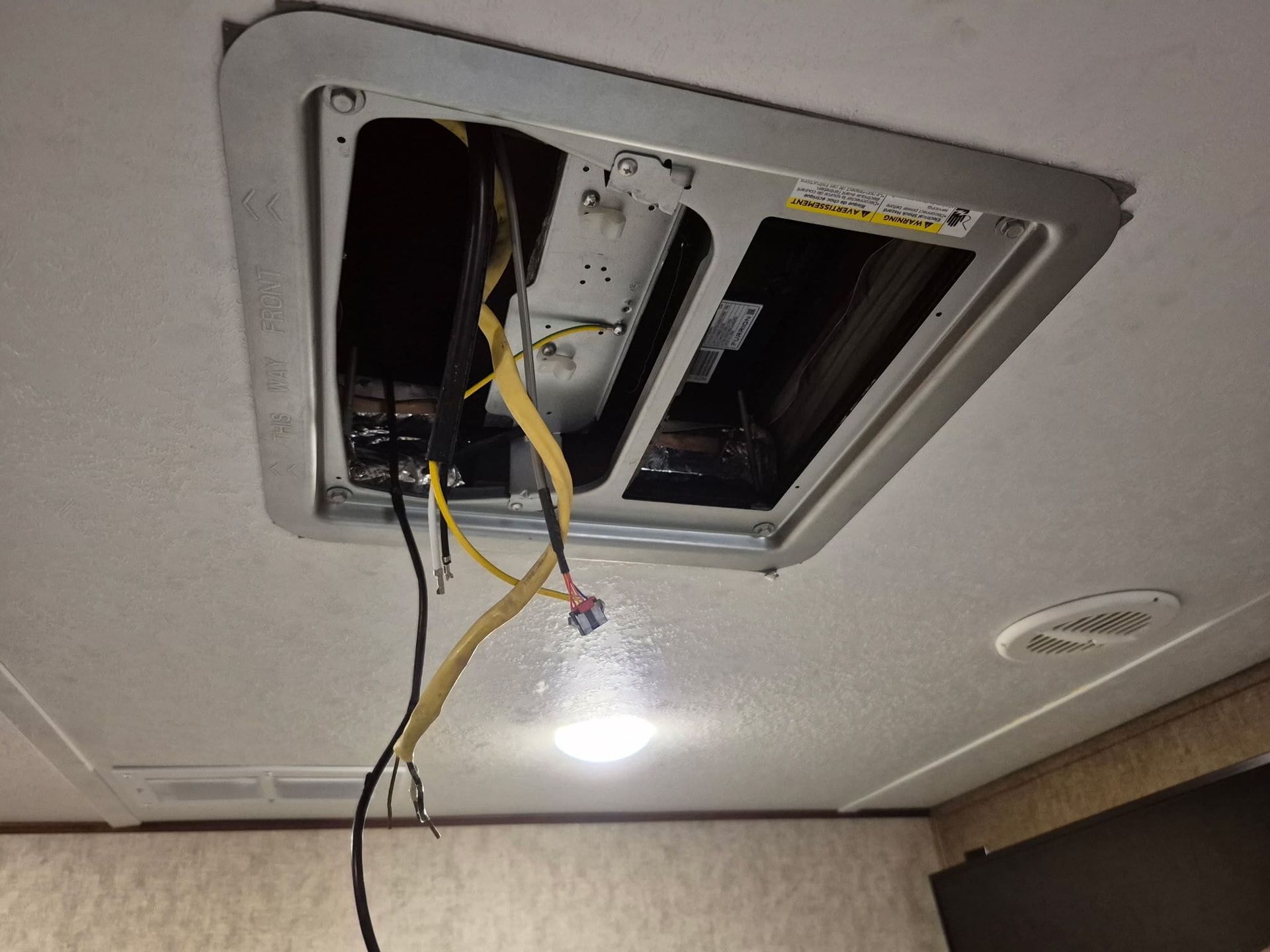
Modern RV air conditioners use electronic control boards to manage thermostat inputs, fan speeds, and compressor operation. When a control board fails, the air conditioner may not respond to thermostat commands, or it may run the fan without engaging the compressor, or it may display error codes on digital thermostats.
Technicians diagnose control board problems by testing the inputs and outputs with a multimeter, verifying that the board receives proper voltage and thermostat signals and that it sends the correct control voltages to the compressor contactor and fan motor. If the board fails these tests, replacement restores normal operation without requiring any changes to the compressor, coils, or other major components.
Control boards are model-specific, so technicians must identify the exact air conditioner model and order the correct replacement board. Installation typically takes less than an hour once the part arrives, making it a cost-effective repair compared to full unit replacement. RV owners looking to find AC repair options in Grandview can have control boards tested and replaced during a mobile service visit without needing to remove the entire rooftop unit.
How Does Grandview's Rural Setting Affect Electrical Diagnostic Needs
Grandview's location in a rural area means many RV owners rely on generator power or limited-capacity shore power at campsites, conditions that increase the likelihood of voltage-related air conditioning problems.
Generators that are undersized or poorly maintained may not provide stable voltage under load, causing the air conditioner to cycle erratically or fail to start. Technicians must test the power source as part of the diagnostic process to rule out generator issues before attributing problems to the air conditioner itself.
Long extension cords or undersized wiring between the power source and the RV can also cause voltage drop that prevents the air conditioner from operating correctly. Measuring voltage at the RV's inlet and again at the air conditioner helps identify wiring losses that must be corrected to restore reliable cooling.
Accurate electrical diagnostics ensure that repairs address the actual problem rather than replacing components unnecessarily. We Get Around RV Repair provides mobile RV AC electrical diagnostics throughout the Grandview area, bringing the specialized test equipment and technical knowledge needed to isolate electrical faults quickly and recommend the most cost-effective repair.