Why Your RV AC Stops Cooling in the Texas Heat — And What to Do Next
If your RV air conditioner is running but pushing out warm air, the problem is not always a broken unit — sometimes the Texas heat itself is the cause. Grandview and the broader Johnson County area regularly hit 100°F–110°F during summer, and most RV rooftop AC units are only rated to cool roughly 20°F below the outside temperature. That means on a 105°F afternoon, the best your unit can physically deliver is around 85°F interior — even when everything is working perfectly.
When It's Running But Not Cooling: What That Actually Means
A running fan with little or no cold air points to a cooling-capacity problem, not a total electrical failure — and that distinction changes the diagnostic path completely.
When the fan runs but the air stays warm, the compressor may still be operating but struggling. That is different from a unit that won't power on at all. The cause-by-cause list below is specific to this 'running but not cold' scenario, which is the most common summer complaint RV owners in the DFW corridor report.
The Most Common Reasons Your RV AC Loses Cooling Capacity
Most RV air conditioning problems that show up as 'running but not cooling' trace back to one of six causes — each made worse by Texas summer conditions.
Dirty or clogged air filters are the most overlooked cause. Restricted airflow forces the evaporator coil to drop below freezing, which forms ice and blocks cooling almost entirely. Cleaning or replacing the filter can restore normal performance without any other repair.
Low refrigerant or a refrigerant leak is a sealed-system problem. RV AC units do not consume refrigerant over time — if the charge is low, there is a leak somewhere. Low refrigerant means the compressor runs but cannot transfer enough heat, so the air coming out stays lukewarm. This always requires a professional recharge after finding and fixing the leak.
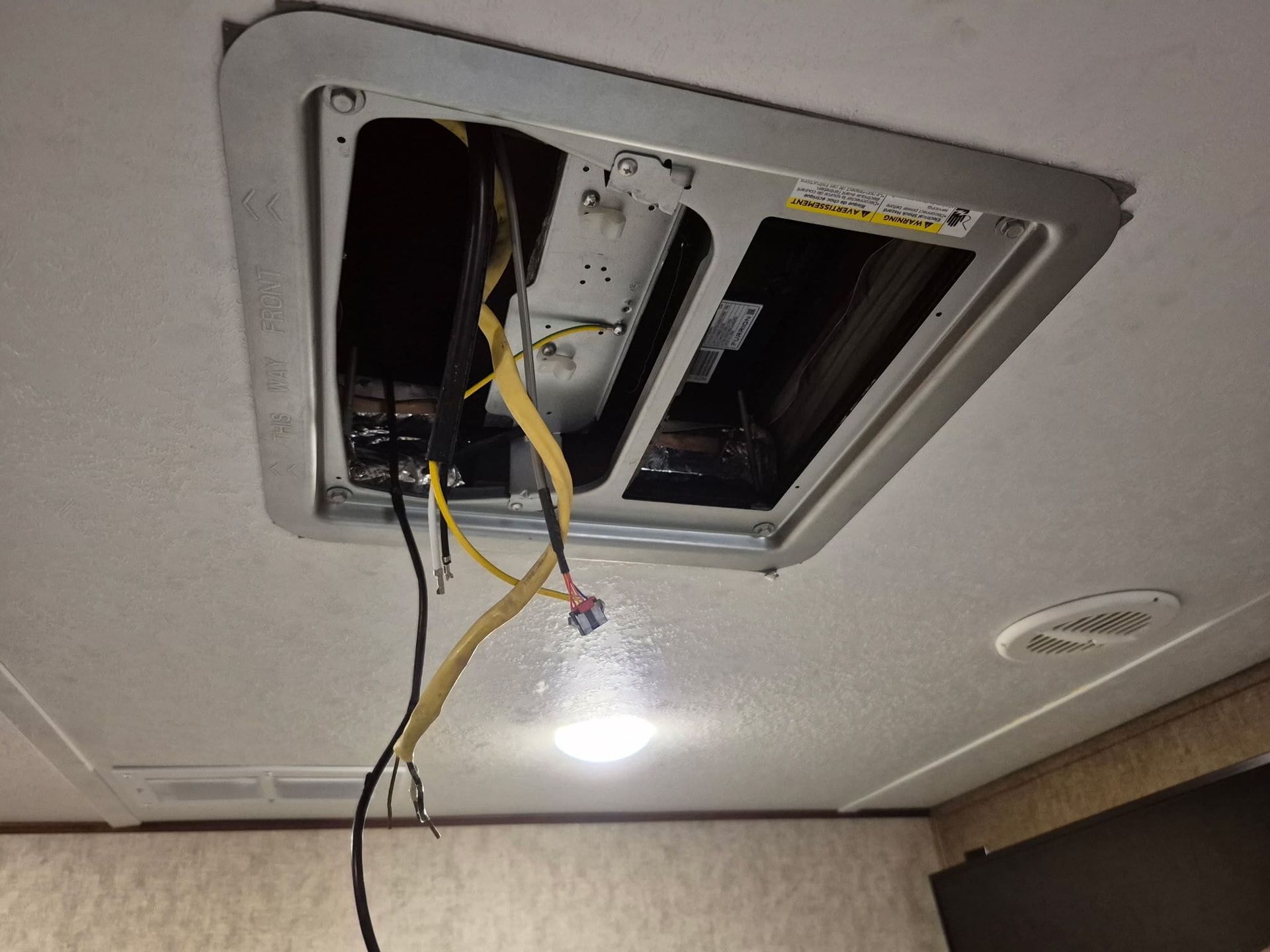
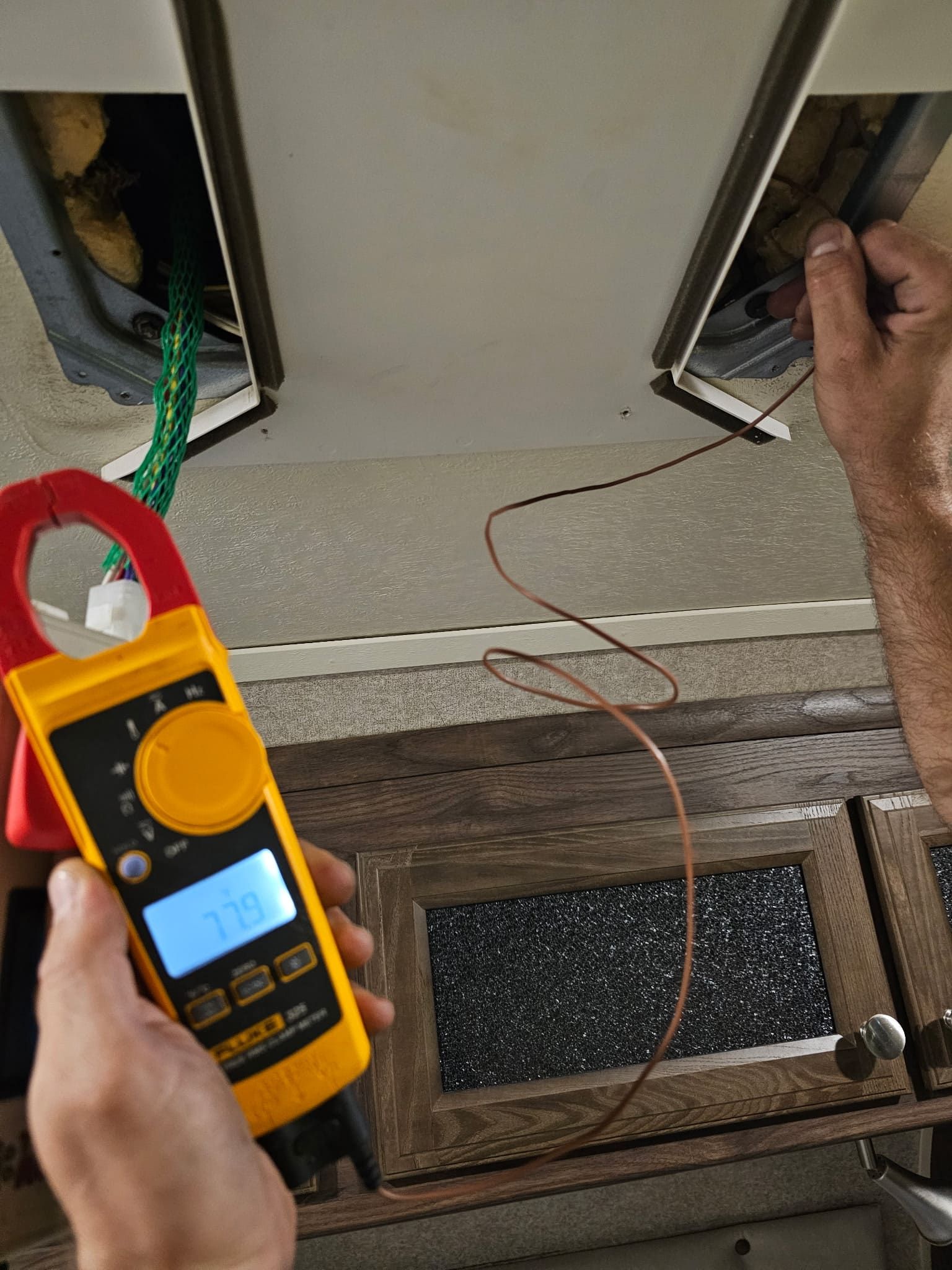
Electrical faults are especially common in aging RV systems. A failing capacitor, bad compressor relay, or voltage drop from a weak shore power connection can all prevent the compressor from reaching full output. RV electrical AC diagnostics checks voltage at the unit, capacitor health, and compressor amp draw to isolate these faults quickly.
Thermostat miscommunication happens when the sensor reads the wrong temperature — either due to poor placement near a heat source or calibration drift over time. The unit thinks it has reached the set point and cycles off before the interior actually cools down.
Oversized heat load is a Texas-specific reality. If your unit is undersized in BTUs for your rig, or if you are parked in direct sun on a hot day, the ambient temperature may simply exceed what the system was designed to handle. Adding shade or parking to minimize roof sun exposure can reduce load enough to make a real difference.
Blocked or dirty condenser coils trap heat that should be exhausted outside. After a dusty Texas off-season, coil buildup is common and causes the compressor to work harder while delivering less cooling — a direct cause-and-effect that wears out components faster.
How Does Texas Summer Heat Make Every Problem Worse?
Any underlying issue that reduces cooling efficiency by 10–15% is barely noticeable at 75°F outside — but at 105°F, that same deficiency can mean the difference between a comfortable interior and a dangerous one.
Texas humidity compounds this further. Even when temps 'only' reach the mid-90s, high humidity raises the effective heat load the AC must overcome. An RV roof absorbs radiant heat beyond the ambient air temperature, so the actual thermal load the unit fights can be significantly higher than what the thermometer shows.
Grandview sits about 35 miles south of Fort Worth, putting it squarely in the southern DFW heat corridor where July and August regularly push heat indexes past 110°F. A unit with a marginal refrigerant charge or partially clogged coils that survived spring travel may collapse entirely under that load.
Repair or Replace? Deciding Which Path Makes Sense
A unit under about 7–8 years old with a single failed component — a capacitor, relay, or thermostat — is almost always worth repairing. If refrigerant loss is minor and the leak is accessible, a recharge and repair is the right call. RV air conditioning repair and replacement covers both paths so you get an honest recommendation based on what the diagnostic actually finds.
Replacement becomes the smarter investment when the unit is 10 or more years old, the compressor has failed, or you have had repeat refrigerant losses. If repair costs are approaching the price of a new unit, replacement locks in better efficiency and a fresh warranty rather than buying temporary relief on an aging system.
A tune-up sits between those two — when performance has degraded but no hard failure has occurred. Pre-season service in April or May is the best time to catch marginal issues before the peak heat arrives.
Does It Qualify as an Emergency or Can It Wait?
Treat it as an emergency if outside temps are over 100°F and you have elderly occupants, children, or pets inside; if you smell burning near the unit; or if a breaker is tripping repeatedly. Complete loss of cooling in those conditions is a health and safety issue, not just a comfort problem.
A scheduled appointment makes sense if you noticed reduced cooling early in the season, the unit is running longer than usual to reach the set temperature, or you want pre-trip diagnostics before summer travel. Catching a marginal issue in May costs far less than an emergency call in August.
What to Expect From a Mobile RV AC Diagnostic Visit in Grandview
A mobile technician comes to your location — no need to tow your RV to a shop, which matters if you are parked at a rural property or a site in Johnson County. During the visit, the tech checks filter condition and airflow, refrigerant pressure and charge level, capacitor and relay condition, compressor amp draw, voltage quality at the unit, thermostat calibration, and the condition of both the evaporator and condenser coils.
For ducted systems, duct integrity and the return air path get checked as well, since a collapsed duct can mimic refrigerant loss in terms of airflow symptoms. The diagnostic gives you a clear picture of what failed, what is marginal, and what still has life — so the repair-or-replace decision is based on data, not guesswork.
Scheduling before July is the practical move in the Grandview area. Peak demand in July and August means longer lead times for non-emergency appointments, while May and June still have open slots for tune-ups and preventive work.
Getting a clear diagnosis early in the season means smaller repairs, lower costs, and no scramble during the hottest weeks of a Texas summer.
Schedule your RV AC diagnostic with We Get Around RV Repair before the heat peaks and let a mobile technician bring the answers to your door.